LFGB vs FDA Food Contact Compliance Explained
Two frameworks. Two different questions. Here is what the labels really mean, what a laboratory actually tests, and which documents to ask for before you place an order.
Ask five suppliers whether their pans are LFGB and FDA approved and you will likely get five different answers. The confusion is understandable: both phrases appear on certificates, catalogues and marketplace listings, yet neither works like a single global passport for cookware.
This guide is written for brand owners, sourcing managers and retailers who need a practical answer, not a legal thesis. It explains the real difference between the German/EU and US approaches, shows which tests matter for metal kitchenware, and gives you a short checklist you can paste into your next supplier email.
1. The short answer
If you only remember three things
- LFGB is German law (sections 30 and 31) operating alongside the EU framework Regulation (EC) 1935/2004. It asks whether the finished article can harm health and whether it changes food by transferring taste, odour or colour. Evidence is a lab report on the actual article, plus a declaration of compliance where one is required.
- FDA compliance is a US substance-based system: each food contact substance must be cleared for its intended use through 21 CFR rules, GRAS status, prior sanction or an effective Food Contact Notification. FDA does not issue a certificate for each finished pan.
- They are not interchangeable. An LFGB report does not by itself answer a US buyer’s question, and an FDA statement does not replace EU or German documentation. If you sell in both regions, plan for both from the start.
One more useful distinction: compliance is a property of a defined product — a specific SKU, made from specific materials, under specific conditions of use. It is not a permanent property of a factory or a logo.
2. What LFGB really means
LFGB stands for Lebensmittel-, Bedarfsgegenstände- und Futtermittelgesetzbuch — the German Food, Consumer Goods and Feed Code. Two sections matter for cookware:
- Section 30 prohibits manufacturing or placing on the market articles whose material can harm health in normal or foreseeable use.
- Section 31 points to Article 3(1) of Regulation (EC) 1935/2004: materials must be made under good manufacturing practice and must not transfer constituents to food in quantities that could endanger health, bring an unacceptable change in composition, or spoil taste and smell.
That last phrase is the reason LFGB is often described as stricter than a purely chemical check. A pan can be non-toxic and still fail if it gives a curry a metallic smell. In practice, laboratories demonstrate this with migration tests in food simulants and a sensory test such as DIN 10955 or an equivalent method.
For metal kitchenware, the typical evidence file includes the alloy or material description, migration results for relevant simulants, specific release results where required (for example nickel or heavy metals), a sensory assessment, and a traceable link to the product tested. Plastic components, coatings and printed parts bring their own requirements — a compliant stainless body does not automatically make a plastic handle compliant.
3. What FDA compliance really means
In the United States, the FDA regulates food contact substances rather than certifying each finished utensil. A substance may be cleared for food contact through one of several routes:
- A regulation in Title 21 of the Code of Federal Regulations (for example, parts 174–178 cover indirect food additives such as resins and polymer coatings).
- GRAS (generally recognised as safe) status for the intended use.
- A prior sanction for uses authorised before 1958.
- An effective Food Contact Notification (FCN), which is specific to the notifier or supplier and to the conditions of use described in the notification.
Clearance is tied to the substance, the supplier and the intended conditions of use: food type, contact temperature, contact time and whether the article is single-use or repeated-use. This is why a generic “FDA food grade” sentence on a catalogue is not evidence. The useful question is: which substance, in which component, under which use conditions, is cleared by which citation?
For a stainless steel pan with a coating and a synthetic handle, a practical file normally includes a material/formulation review with the relevant 21 CFR citations, extractables or migration testing under conditions that reflect actual use, and a clear statement of the intended use. Note also that California Proposition 65 is a separate state requirement, not an FDA approval.

4. Side-by-side comparison
| Question | LFGB / Germany–EU | FDA / United States |
|---|---|---|
| Legal home | LFGB §§30–31 plus Regulation (EC) 1935/2004; harmonised rules such as (EU) 10/2011 for plastics apply where relevant. | Federal Food, Drug and Cosmetic Act; 21 CFR parts 170–189; inventory of effective FCNs. |
| Unit of assessment | The material and the finished article as used, including coatings and components. | Individual food contact substances and their intended conditions of use. |
| Core safety question | No health hazard, no unacceptable change to food, no transfer of taste, odour or colour. | Is each substance cleared for this use, and is migration within the applicable limits? |
| Typical evidence | Accredited lab test report on the actual article; declaration of compliance where required; traceability records. | 21 CFR citations, FCN / GRAS / prior sanction documentation; extractables and migration testing for the intended use. |
| Sensory testing | Explicit, widely requested practice (taste and odour). | Not a general finished-article approval requirement. |
| Official mark | No single government product mark; laboratory reports and optional lab-owned marks are common. | No FDA certificate for a finished pan; “FDA approved” on a product is shorthand and can mislead. |
| Validity | Tied to the article, materials, supplier and process. Retest after a relevant change. | Tied to the substance, supplier and use conditions stated in the citation or notification. |
| Best claim wording | “Tested to LFGB §§30–31; report available on request.” | “Food contact materials comply with applicable 21 CFR requirements for the stated use.” |
5. What actually gets tested on a pan
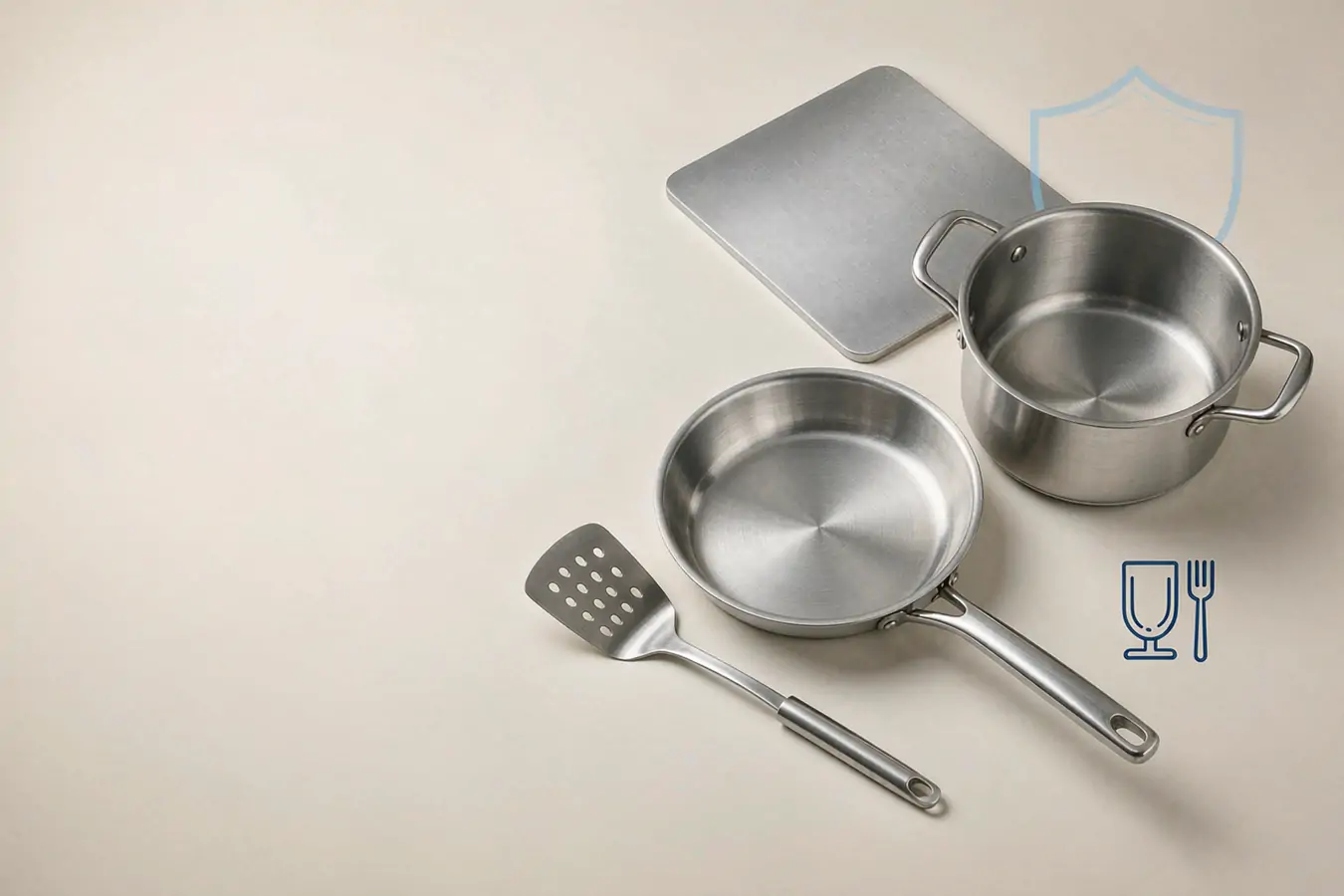
Buyers often imagine one universal “food safe” test. In reality, a test plan follows the parts of the article and the way it will be used. The illustration below shows the questions a laboratory asks for a typical metal cooking pan.
For outdoor products the same logic applies with harsher assumptions: a stainless steel Flammlachsbrett is used over open fire, so the test conditions should reflect high heat and repeated contact. For a metal cutting board, abrasion and repeated washing matter. Ask your supplier which conditions were simulated, not just whether the product “passed”.
6. Read a test report in 60 seconds
You do not need to be a chemist to spot a weak report. Check these six things in order:
Look for an accredited independent laboratory (ISO/IEC 17025 scope where relevant), a report number and a date. A letter on factory letterhead is not a test report.
The report must name the exact article or material, including coatings and components. “Stainless steel cookware” is too vague to cover your SKU.
Food simulant, temperature, contact time and number of cycles should match how the product will really be used. A room-temperature test does not prove high-heat safety.
Measured results should be shown against the applicable limit. A bare “passed” without numbers tells you very little.
An LFGB report answers German/EU questions. Ask separately for US-facing 21 CFR documentation. Different markets, different files.
Changed alloy, coating supplier, printing ink or process? The old file may no longer describe the product you are buying. Request a fresh check.
7. Which compliance file do I need?
Start with the destination market, then work backwards to the materials. This is the shortest path we use with new buyers.
A practical tip: send the same production samples to the laboratory for both markets. You will pay for one sampling and handling cycle, and the reports will describe the same article — which makes the file far easier for a retailer to audit.
8. Claims that get buyers into trouble
Most compliance disputes start in the marketing copy, not in the laboratory. Use precise language and keep the evidence behind it.
| Avoid saying | Say instead | Why it matters |
|---|---|---|
| “LFGB certified by the German government” | “Tested to LFGB §§30–31; report available on request” | There is no single government product certificate for a pan. |
| “FDA approved cookware” | “Food contact materials comply with applicable 21 CFR requirements for the stated use” | FDA clears substances and uses, not each finished article. |
| “Food grade stainless steel, therefore compliant” | “304 / 316 stainless body; migration results attached for the intended use” | Alloy grade alone does not prove suitability for every use. |
| “All products are LFGB and FDA certified” | “Compliance on selected products; reports supplied by SKU on request” | Only state what the actual test reports cover. |
| “Our certificate is valid forever” | “Report dated [month/year], covering the current material and process” | Reports describe a specific article at a specific time. |
That fourth line is worth highlighting. If only some SKUs have been tested — a common situation for growing factories — say so plainly. Buyers respect an honest scope note far more than a claim that collapses during an audit. It is the same principle we use on our own catalogue: LFGB and FDA compliance applies to selected products, with documentation available for the exact item you are sourcing.
9. Frequently asked questions
Is LFGB the same as FDA food contact compliance?
No. LFGB is German law working alongside the EU framework regulation 1935/2004. FDA compliance is a US system built on 21 CFR rules, GRAS, prior sanction and effective food contact notifications. They answer related but different questions, and neither replaces the other.
Does the FDA approve finished cookware?
FDA does not issue a certificate for each finished pan or utensil. It regulates the substances used and their intended conditions of use. A credible supplier shows the relevant citations or notification plus testing that reflects how the product will be used.
Do I need both LFGB and FDA documentation?
If you sell into Germany or the wider EU and into the United States, yes. Build one test plan that covers both markets using the same production samples, and keep the reports tied to the exact SKU, material and coating.
How long is a food contact test report valid?
There is no single universal expiry date set by law. A report is only valid for the article, material, supplier and process it describes. Most buyers expect a recent report and a retest after any relevant material or process change.
Can an LFGB report be used for US customers?
Not on its own. It is evidence against German and EU requirements. US buyers need a separate demonstration that each food contact substance is cleared for its intended use under FDA rules.
What about the “food contact” symbol on packaging?
In the EU, articles sold empty generally need a food-contact indication, a specific use description or the glass-and-fork symbol, together with the responsible business’s name and address. The symbol is a labelling duty — it is not proof that testing was done.