In the competitive world of cookware retail, price is often the first thing a buyer looks at. When comparing a standard stainless steel pan with an impact-bonded bottom to a full-body tri-ply clad pan, the price gap can be significant.
But as a manufacturer with decades of experience on the factory floor, I can tell you: that extra cost isn’t just a markup—it’s a performance insurance policy. If you want to move your brand from “commodity” to “premium,” you need to understand why your customers will eventually demand tri-ply.
The Anatomy of Heat: Full-Body Clad vs. Impact Bonded
To understand the value, we have to look under the hood—or rather, inside the steel.
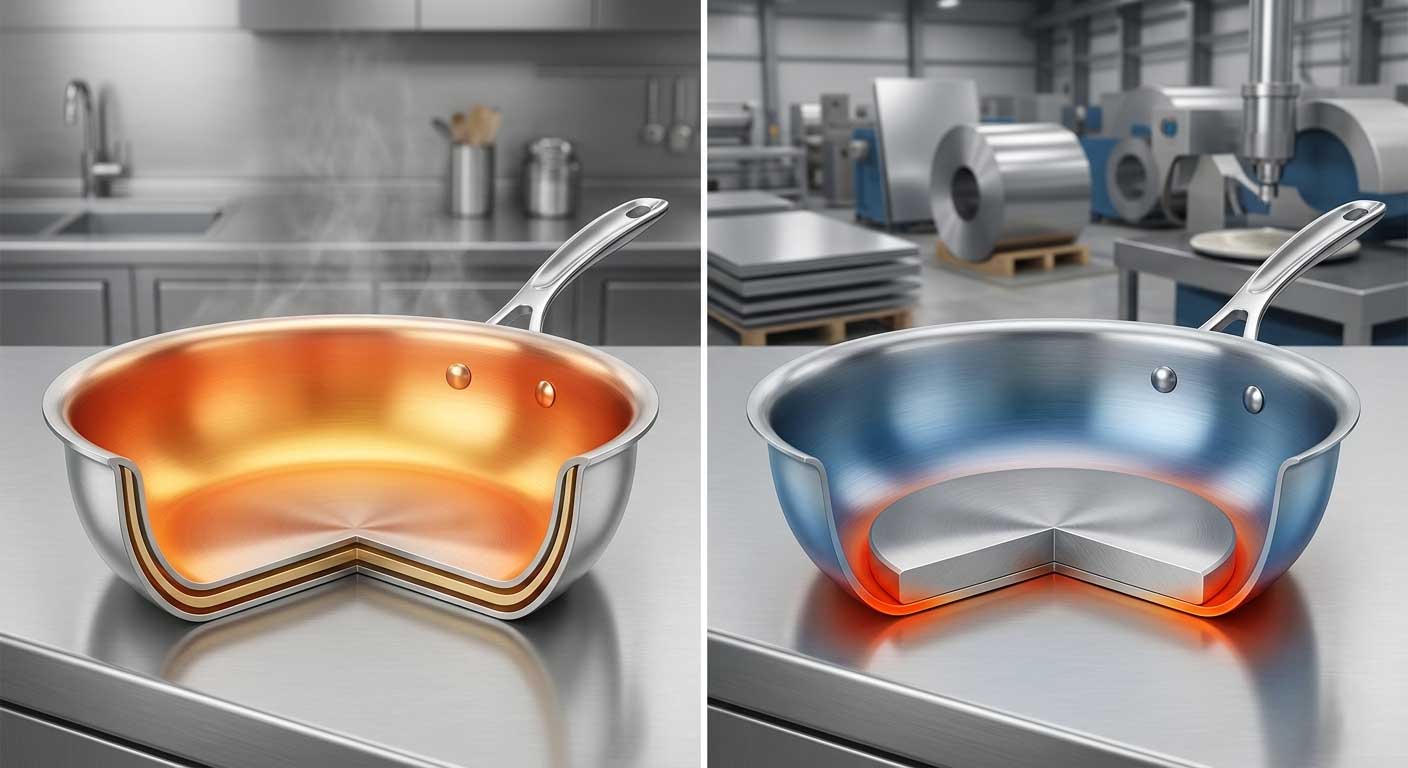
Impact-Bonded Cookware (often called “capsule bottom”) features a thick disk attached only to the base. While the bottom conducts heat well, the side walls remain thin, single-layered stainless steel.
The Result: “Hot spots” at the corners and cold zones on the sides. Food scorches at the base while the rest stays undercooked.
Tri-Ply Clad Cookware is a different beast entirely. It consists of three layers of metal—usually 304 Stainless Steel (interior), Aluminum (the core), and 430 Stainless Steel (the exterior)—bonded together from the base all the way to the rim.
Why the “Full-Body” Construction Wins
1. 360-Degree Heat Distribution
Because the aluminum core extends to the very top of the rim, the entire pan becomes a uniform heating surface. This eliminates the “thermal ring” common in cheap pans. For a professional chef or a serious home cook, this means sauces don’t burn at the edges and proteins sear evenly.
2. Induction Compatibility & Warp Resistance
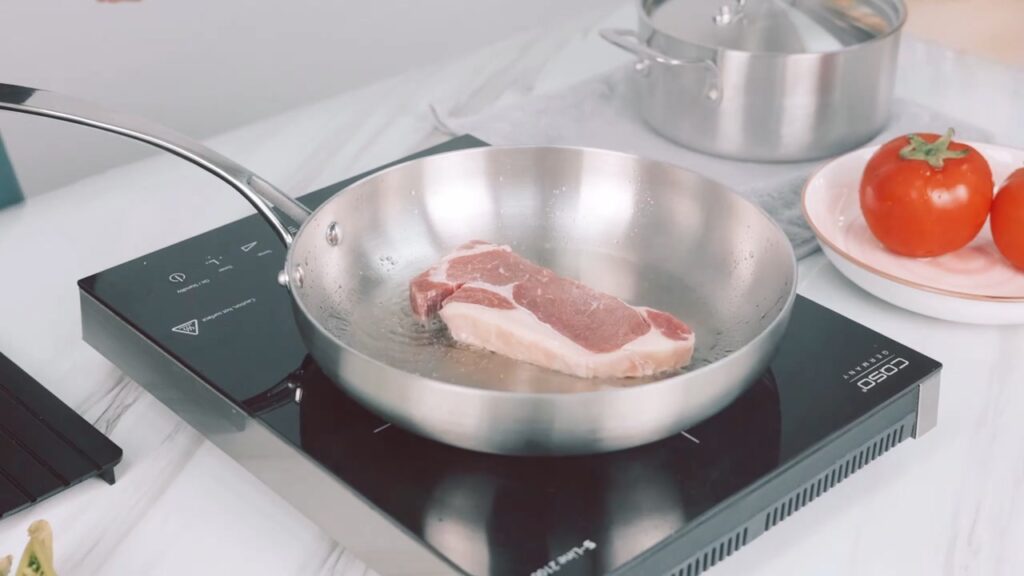
Our factory uses a specialized 430 magnetic stainless steel for the outer layer. This makes tri-ply pans natively compatible with induction cooktops. Furthermore, the bonded “sandwich” structure acts like a structural beam, making the pan significantly more resistant to warping under high heat compared to single-ply walls.
3. Lifetime Durability (The “Asset” vs. “Expense”)
Impact-bonded bottoms are held together by a mechanical bond. Over years of thermal expansion and contraction, these disks can eventually loosen or “pop” off. Tri-ply is a molecular bond—it is essentially one solid piece of metal. It is an heirloom-quality product that justifies a higher retail price because it never needs replacing.
The Business Case: Lower Returns, Higher Margins
For wholesalers and brand owners, selling tri-ply isn’t just about selling a better pan; it’s about brand equity.
Reduced Returns: High-quality clad steel rarely suffers from the structural failures seen in budget cookware.
Premium Positioning: You aren’t competing with supermarket clearance bins. You are competing with high-end kitchen boutiques.
Health & Safety: With growing concerns over PFAS and chemical coatings, “pure” tri-ply stainless steel is the gold standard for the health-conscious consumer.
The Factory Advantage
As a direct manufacturer, we control the “Golden Ratio” of these layers. We ensure the aluminum core is thick enough for maximum conductivity without making the pan too heavy for daily use. When you source directly from the factory, you aren’t just buying a product; you’re buying the R&D that goes into every millimeter of that clad steel.
Ready to upgrade your product line? Don’t let your customers settle for “good enough.” Contact our team today to request a sample of our signature 2.5mm Tri-Ply series and see the manufacturing difference for yourself.