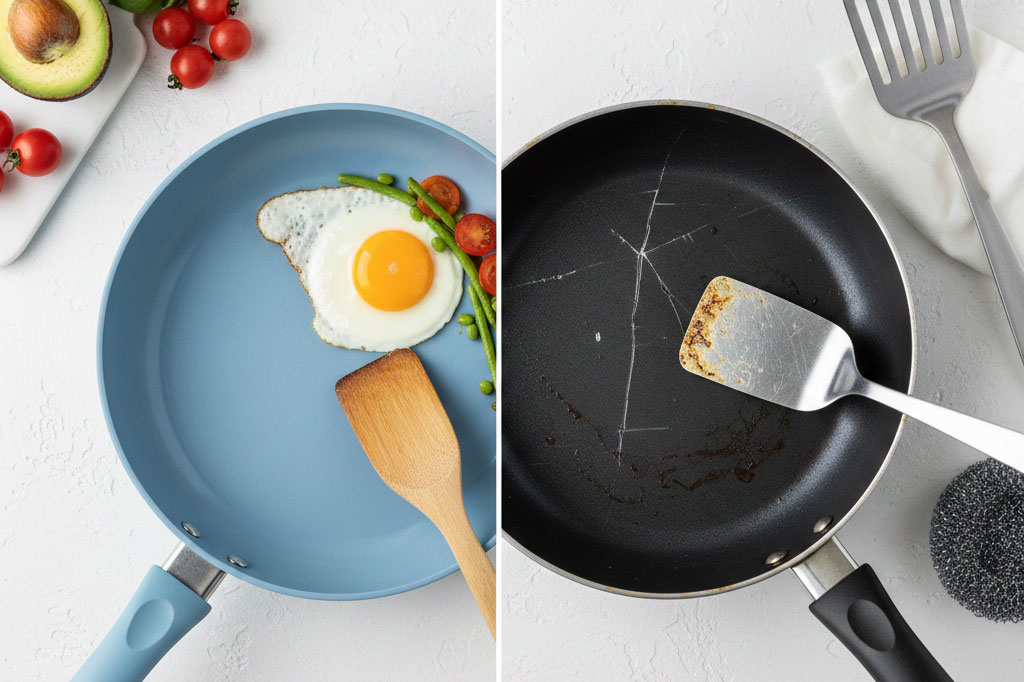
Ceramic coatings (often referred to as nano-ceramic paint) used in tableware are high-tech coatings primarily composed of inorganic silicates. Unlike traditional ceramic “glazes,” these are typically applied via spraying and cured at low temperatures (approximately $200$°C–$300$°C) onto metal (such as aluminum or stainless steel) or glass substrates, providing a “non-stick” property and a ceramic-like feel.
Pros
Health & Eco-Friendly: Unlike traditional Teflon (PTFE) coatings, ceramic coatings are free of PFOA and PFAS. They do not release toxic fluorides at high temperatures, making them a safer choice.
High Temperature Resistance: They offer excellent thermal stability, typically withstanding temperatures above $400$°C without decomposing, even during dry heating.
Aesthetic Appeal: Available in a wide range of colors with high gloss, they provide a smooth, warm texture similar to real porcelain.
Easy to Clean: Their hydrophobic and oleophobic properties prevent food and grease from sticking, making cleanup effortless.
Cons
Short-lived Non-stick Effect: Due to their brittle microscopic structure, the non-stick performance tends to degrade faster than traditional coatings over time.
Brittleness & Chipping: While hard, they lack toughness. Impact from hard objects or scraping with metal utensils can cause the coating to crack or chip.
Sensitivity to Detergents: Strong alkaline detergents or high-pressure cycles in dishwashers can accelerate aging. Hand washing is generally recommended.
Recommendation: To extend the lifespan of ceramic-coated tableware, use wooden or silicone utensils and avoid sudden, extreme temperature changes.